
Applications of Electric Stacker in Warehousing and Industrial Operations (1.5 Ton to 3.0 Ton Models)
Updated: Apr 9

Applications of Electric Stacker
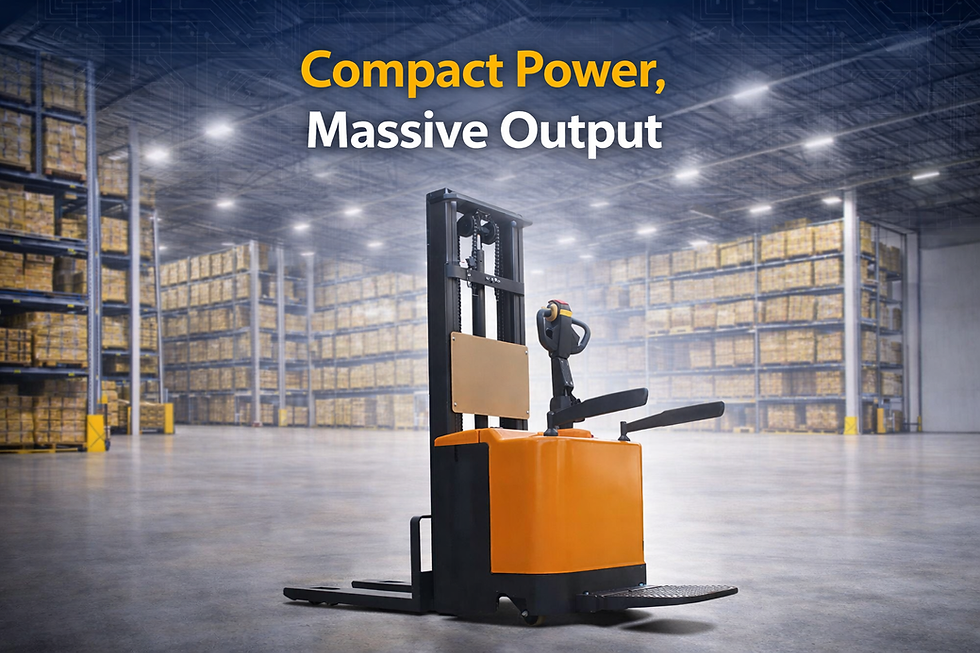
An electric stacker is a versatile material handling machine designed to lift, stack, and transport palletized goods within warehouses and industrial facilities. With the growing demand for organized storage and faster material movement, electric stackers have become essential equipment across many industries.
Unlike manual handling methods, electric stackers use motorized lifting and controlled movement to reduce physical effort and improve accuracy. HUB Solution offers electric stackers in 1.5 ton, 2 ton, 2.5 ton, and 3.0 ton capacities, making them suitable for a wide range of operational requirements.
Application in Warehousing and Distribution Centers
Warehouses and distribution centers handle large volumes of goods that need to be stored and retrieved efficiently. Electric stackers are widely used in these facilities for daily storage operations.
They are commonly used for:
Moving pallets from receiving docks to storage racks
Stacking goods at low to medium rack heights
Retrieving pallets for order dispatch
Organizing inventory within narrow aisles
Electric stackers help maintain structured storage layouts and reduce congestion in warehouse aisles, improving overall workflow.
Application in FMCG and Retail Storage
Fast-Moving Consumer Goods (FMCG) and retail warehouses store packaged products that move quickly in and out of storage. These facilities require frequent pallet movement and accurate stacking.
Electric stackers support FMCG and retail storage by:
Enabling quick stacking of cartons and packaged goods
Supporting FIFO (First In First Out) inventory systems
Reducing manual lifting of goods
Improving speed of order preparation
For lighter goods, a 1.5 ton electric stacker is commonly used, while larger retail warehouses prefer 2 ton models for higher productivity.
Application in Pharmaceutical and Healthcare Warehouses
Pharmaceutical warehouses require strict control over hygiene, safety, and product handling. Since electric stackers operate without emissions, they are suitable for indoor and clean environments.
They are used in pharmaceutical facilities for:
Handling medicine cartons and chemical supplies
Storing sensitive products at rack levels
Operating inside temperature-controlled rooms
Maintaining organized storage systems
The smooth lifting action of electric stackers helps prevent damage to delicate pharmaceutical products.
Application in Food and Beverage Storage
Food and beverage warehouses store packaged food items, beverages, and raw materials that must be handled carefully and hygienically.
Electric stackers are commonly used in this sector for:
Moving food-grade pallets
Storing products in cold rooms and dry storage
Supporting systematic stock rotation
Operating in enclosed spaces without fumes
Their clean operation and precise handling make them ideal for food-related storage environments.
Application in Manufacturing and Industrial Units
Manufacturing plants and industrial warehouses store raw materials, components, and finished products. These materials are often heavier and stored in bulk.
Electric stackers are used in manufacturing units for:
Transporting raw materials to production areas
Moving finished goods to storage zones
Handling industrial pallets safely
Supporting internal logistics flow
For heavier materials, 2.5 ton and 3.0 ton electric stackers are commonly used due to their higher load-handling capability.
Application in E-Commerce and Fulfillment Centers
E-commerce warehouses require fast and accurate order fulfillment. Products are stored at different rack levels and must be accessed quickly.
Electric stackers support e-commerce operations by:
Enabling fast stacking and retrieval
Supporting narrow aisle layouts
Reducing picking and handling time
Improving storage organization
Their ability to operate in compact spaces helps e-commerce businesses manage large inventories efficiently.
Application in Cold Storage and Temperature-Controlled Facilities
Cold storage warehouses store perishable and temperature-sensitive goods such as frozen foods and medical supplies.
Electric stackers are suitable for cold storage because:
They operate without exhaust emissions
They provide smooth and controlled lifting
They support high-density storage systems
They work efficiently in enclosed environments
Their stable handling reduces the risk of product damage in low-temperature conditions.
Role of Electric Stackers in Space Optimization
One of the main reasons electric stackers are used across industries is their ability to optimize storage space. By stacking pallets vertically and operating in narrow aisles, electric stackers help warehouses store more goods in the same floor area.
This results in:
Increased storage density
Reduced need for warehouse expansion
Better inventory organization
Improved use of available floor space
Space optimization is especially important in urban and industrial areas where warehouse space is limited.
Selecting the Right Electric Stacker for Different Applications
The choice of electric stacker depends on:
Type of goods handled
Average pallet weight
Rack height
Aisle width
Working environment
For lighter goods and smaller warehouses, a 1.5 ton electric stacker is suitable. For mixed storage and medium warehouses, a 2 ton electric stacker works well. For heavy industrial loads, 2.5 ton or 3.0 ton electric stackers are preferred.
Matching capacity with application ensures safe and efficient operation.
Safety Considerations in Different Applications
Different applications require different safety practices. In pharmaceutical and food warehouses, smooth handling is essential to prevent product damage. In industrial environments, extra care must be taken when lifting heavy pallets.
Common safety measures include:
Operator training
Load capacity awareness
Regular equipment inspection
Clear aisle markings
These measures help ensure reliable and accident-free operation.
Maintenance and Operational Reliability
Electric stackers used in different industries require regular maintenance to maintain performance. Important maintenance tasks include:
Battery inspection and charging
Checking lifting and hydraulic systems
Inspecting forks and mast
Ensuring braking systems function correctly
Proper maintenance ensures consistent performance and extends equipment life across all applications.
Conclusion
Electric stackers are widely used across industries due to their ability to lift and move palletized goods efficiently in indoor environments. From warehouses and FMCG storage to pharmaceutical, food, industrial, and e-commerce facilities, electric stackers play a vital role in modern material handling operations.
HUB Solution electric stackers in 1.5 ton, 2 ton, 2.5 ton, and 3.0 ton capacities provide dependable solutions for various storage and handling applications. By selecting the right model for the right application, businesses can improve productivity, optimize space, and maintain safe operations.
📞 +91-6356980846


Comments